Moon landings and more: 2025's top space missions | Space Quiz! Do galaxies with supermassive black holes at their center produce new stars faster or slower than galaxies without supermassive black hole? | Satellites map Earth's ocean floors in unprecedented detail
Created for znamenski.spacecom@blogger.com | Web Version
2025 is set to dazzle with a wide array of exciting and spectacular space missions. On tap are a flurry of moon landing attempts, high-profile test launches of SpaceX's Starship megarocket, human spaceflight adventures and asteroid sampling missions. Here's a look at some of the most alluring space events expected in the coming year.
Space Quiz! Do galaxies with supermassive black holes at their center produce new stars faster or slower than galaxies without supermassive black hole?
A new satellite has mapped Earth's ocean floors in unprecedented detail, a new study reveals. The first year of measurements from NASA's Surface Water and Ocean Topography (SWOT) satellite mission, launched in December 2022 and developed by NASA and France's Centre National D'Etudes Spatiales, enabled researchers to study the boundaries between continents and identify underwater hills and volcanoes that are too small to be detected by earlier satellites.
What a start to 2025! While many celebrated New Year's Eve with bursts of glittering fireworks, Earth joined the festivities with a natural display of its own: the northern lights. Two coronal mass ejections (CME) struck Earth's magnetic field, sparking geomagnetic storm conditions and painting the night sky with vivid aurora displays as far south as California U.S., Austria, and Germany. The geomagnetic storms waxed and waned throughout the night, creating a dynamic celestial fireworks show that stretched well into the new year.
NASA's James Webb Space Telescope found evidence that supermassive black holes suppress star formation in maturing galaxies. The team used the James Webb Space Telescope's (JWST) Near Infrared Camera (NIRCam), analyzed 19 galaxies that are part of the Spiderweb protocluster, one of the best studied galaxy groups in the universe, which lies some 11 billion light-years away from Earth.
SpaceX's Starship megarocket may come into its own in 2025. The 400-foot-tall (122 meters) Starship is the biggest and most powerful rocket system ever built, and it's designed to be fully and rapidly reusable. In 2025, SpaceX could try to launch it up to 25 times.
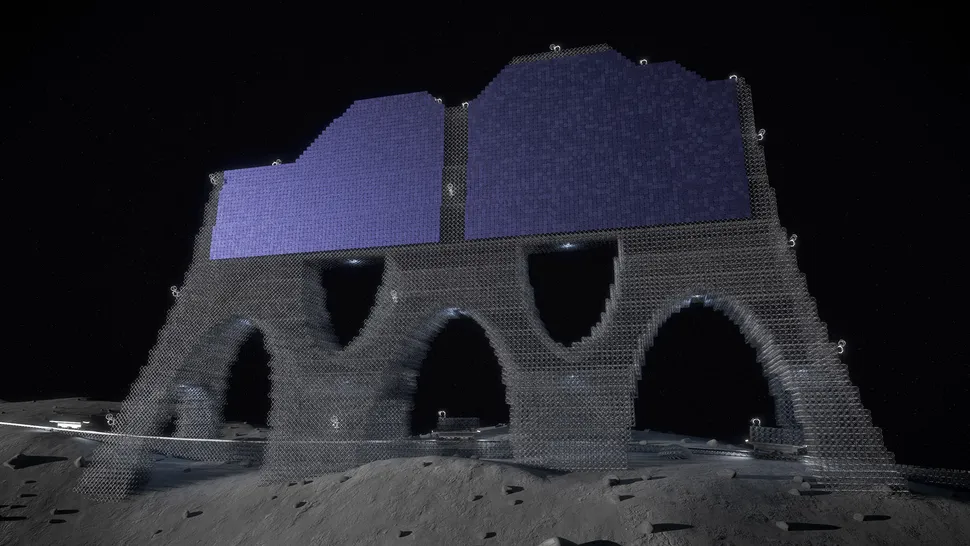
In living things, structures are built from simple, repeatable patterns. These often come in the form of a disorganized lattice. Large structures, like bones or coral, emerge from repeated rounds of growth of a fundamental pattern that builds off of itself in a haphazard way. Now, researchers have designed a flexible material that could pave the way for the development of adaptable space structures.
Ever since the discovery of methane on Mars, scientists have wondered if the Red Planet might harbor life. Now, researchers know where to look: deep under the surface of a broad Martian plain.
"All Good Things", "What You Leave Behind", "Endgame"… Now "The New Next Generation" becomes the latest addition to the pantheon of memorable "Star Trek" season finales, as the franchise's only out-and-out comedy, "Lower Decks", goes out in style.
Will 2025 be the year of Starship? | Get ready for a 'New Year Comet'! Here's what to expect | Auroras, solar eclipse, Starship: Google's Breakout Searches of 2024
Created for znamenski.spacecom@blogger.com | Web Version
SpaceX's Starship megarocket may come into its own in 2025. The 400-foot-tall (122 meters) Starship is the biggest and most powerful rocket system ever built, and it's designed to be fully and rapidly reusable. In 2025, SpaceX could try to launch it up to 25 times.
In the second week of 2025, we could see a new object grace the skies as comet ATLAS (C/2024) G3 gets close to the sun. In the wake of comet C/2023 A3 (Tsuchinshan–ATLAS) in October, comet G3 is due to reach perihelion — its closest to the sun — on Jan. 13, 2025. That day, this icy visitor to the inner solar system will get to within just 8.3 million miles (13.5 million kilometers) from the sun.
This year, Google's "Breakout Searches of the Year," for 2024 were showcased in an emotional YouTube video released earlier this month. Among some of the year's highlights were some of the most epic space stories of the year.
We could be in for a New Year's aurora treat with northern lights potentially visible deep into mid-latitudes tonight and tomorrow (Dec. 30 to Dec. 31). Due to an incoming solar storm, also known as a coronal mass ejection, the National Oceanic and Atmospheric Administration Space Weather Prediction Center issued a G3 (strong) geomagnetic storm warning for Dec. 31.
Auroras are one of the most dazzling shows in the night sky, but to see them, you have to be in the right place at the right time. Our aurora forecast live blog tells you everything you need to know about upcoming geomagnetic activity and the likelihood of seeing the northern lights depending on your location. We will also keep you informed of any significant space weather events such as coronal mass ejections (CMEs) and coronal holes which could bring strong aurora-sparking solar winds our way.
New details about the small pieces of the moon gifted by the United States to Ireland in 1970 have now been unearthed. Unfortunately, the same cannot be said for the Apollo 11 lunar samples, themselves.
2024 was a big year for space science in many ways, but it may well prove to be the most important year for the universe's most troubling and mysterious "ingredient," dark energy, since its discovery almost three decades ago. This was the first year that scientists got an exciting observational hint that the force driving the accelerating expansion of the cosmos could be "growing up."
The year 2024 has been another challenging one for Earth's climate, marked by record temperatures, extreme weather events, and urgent warnings from scientists about the accelerating pace of global warming. An analysis by the Copernicus Climate Change Service (C3S), the European Union agency that tracks global warming, suggests this year will be the hottest since instrument record keeping began more than a century ago — beating climate records set just last year.
SpaceX's launch of 21 new Starlink satellites from Florida marked the company's 134th Falcon flight in 2024, surpassing the company's prior year total by 38 missions. Of this year's launches, 89 were devoted to expanding the Starlink global network.
It seems fair to say that this year has arguably been a page-turner in defining and refining interest in Unidentified Anomalous Phenomena (UAP), a new term — rightly or wrongly — for Unidentified Flying Objects (UFOs), those unknown events or craft seen in our skies.