Perseverance strikes gold: 'All we had hoped for and more' | Planetary Science Caucus 'alarmed' by plans to slash NASA | Space Quiz! From which constellation does the Lyrid meteor shower typically fall?
Created for znamenski.spacecom@blogger.com | Web Version
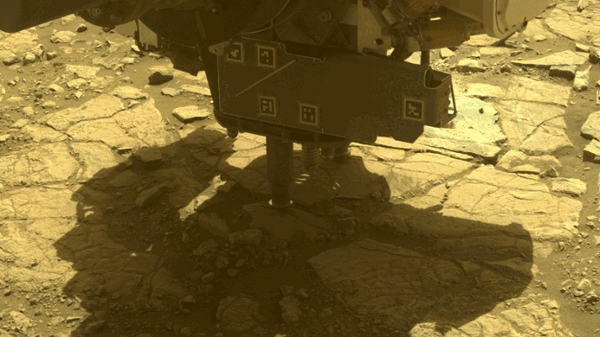
NASA's Perseverance rover is reveling in a scientific bonanza on Mars after finding a diverse array of rocks that are providing eager scientists a glimpse into the planet's ancient history.
Bipartisan U.S. Congressional Planetary Science Caucus co-chairs have chimed into the NASA budget conversation: "We are extremely alarmed by reports of a preliminary White House budget that proposes cutting NASA Science funding by almost half and terminating dozens of programs already well underway, like the Mars Sample Return mission and the Roman Space Telescope," they jointly wrote in a statement.
NASA's Space Launch System (SLS) continues to make progress toward its Artemis 2 mission planned for next year. SLS is currently being stacked inside the Vehicle Assembly Building (VAB) at NASA's Kennedy Space Center (KSC) in Florida, where, the final pieces of the rocket are being assembled.
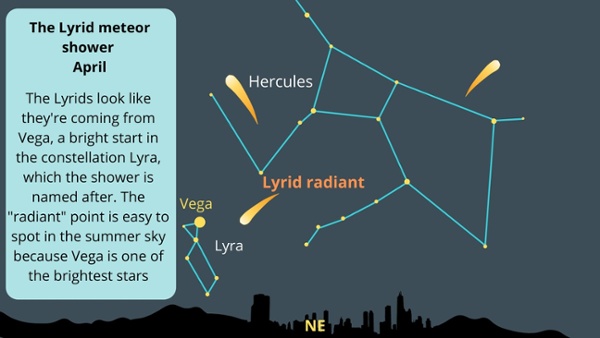
For the best show, head outside during the early morning hours of April 22, as this is the peak of the meteor shower, ideally between 3 a.m. and 5 a.m. local time, just before dawn.
The Japanese asteroid-sampling spacecraft Hayabusa2 has been forced into protective "safe mode" while journeying through deep space. After delivering sample of Ryugu to Earth, the main spacecraft embarked on an extended mission to scope out yet another asteroid. Hayabusa2 is now headed for the small, near-spherical asteroid 1998 KY26, which it's expected to reach in 2031. But it is not currently plain sailing for the extended mission.
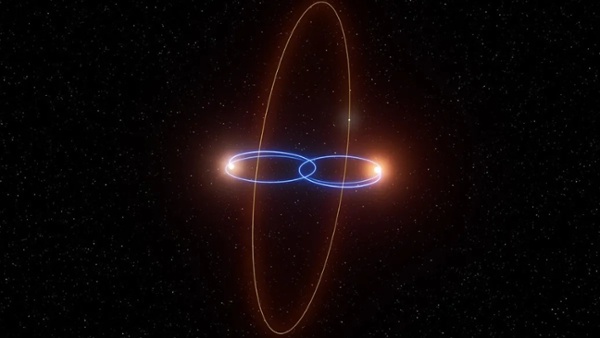
Scientists have perhaps discovered the weirdest planetary system ever seen. Not only does this system feature the first-ever "polar planet" to be discovered, meaning the world exists on a sideways orbit, but that planet also circles around two stars. But that's not all - those parent stellar bodies are also brown dwarfs, better known as "failed stars."
Lindley Johnson has been a pioneer in blueprinting warning and response scenarios to any potential impact of Earth by an asteroid or comet. He led the establishment of the Planetary Defense Coordination Office at NASA in January 2016. Prior to NASA, he served 23 years of Air Force active duty working on a host of national security space systems.
Space.com talked with Johnson, the space agency's Planetary Defense Officer Emeritus, now in phased retirement mode, about his decades of work in shaping a global response and reaction to a rocky world smacking into our planet.