Japanese company ispace will attempt historic moon landing today
Japanese company ispace will attempt moon landing today | Building the 'Moonhouse': Q&A with artist Mikael Genberg | See Resilience's landing zone on the lunar surface
Created for znamenski.spacecom@blogger.com | Web Version
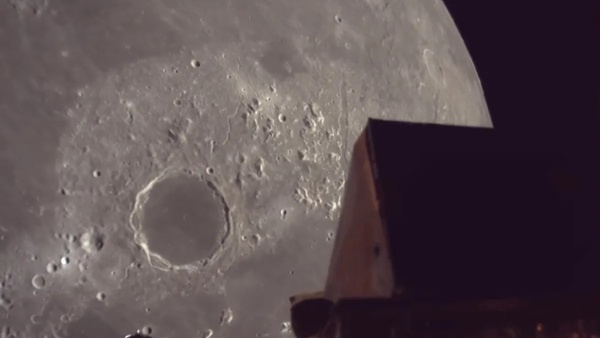
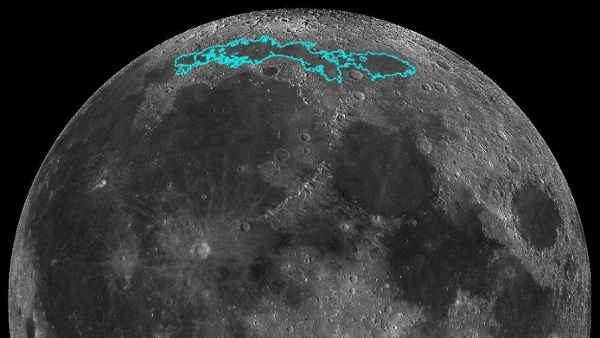
Japanese spaceflight company ispace aims to make history today with its second attempt to land on the moon. The Resilience lander is currently orbiting the moon as it prepares to land within Mare Frigoris ("Sea of Cold") in the moon's northern hemisphere. The landing is scheduled for 3:17 p.m. EDT (1917 GMT; or 4:17 a.m. Japan Standard Time on Friday, June 6). Watch the landing attempt live via ispace, and on Space.com.
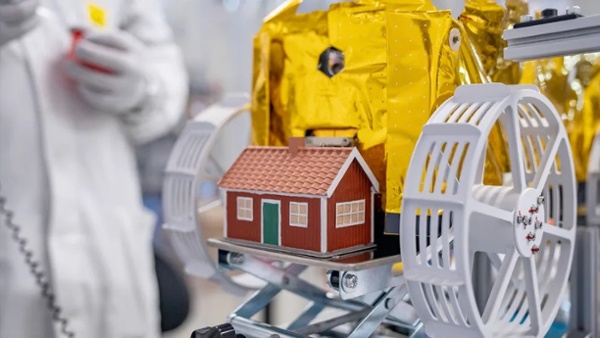
A dream that Mikael Genberg has nurtured for more than a quarter century could come true today (June 5). The Swedish artist's "Moonhouse," a project he devised way back in 1999, is set to touch down on the moon this afternoon aboard Resilience. The artwork - a tiny replica of the red-and-white houses that dot the Swedish countryside - is mounted on the front bumper of Tenacious, a microrover built by ispace's European subsidiary. If Resilience touches down safely today and everything thereafter goes to plan as well, Tenacious will deploy from the lander and drop the Moonhouse onto the lunar dirt, giving the gray landscape a solitary spark of vibrant color.
Resilience is far too small to be seen from Earth, but its approximate landing site on the lunar surface is easily identifiable, if you know where to look. In the nights surrounding June 5, look toward the southeastern sky - the moon will become more visible after sunset.
The Axiom Mission 4 (Ax-4) astronauts, including American commander Peggy Whitson, Indian pilot Shubhanshu Shukla and mission specialists Sławosz Uznański-Wiśniewski of Poland and Tibor Kapu of Hungary, chose a small plush swan named "Joy" as their zero-gravity indicator. The doll, attached to a tether, will be released to float aboard the SpaceX Dragon capsule, signaling that the Ax-4 crew safely made it into low Earth orbit.
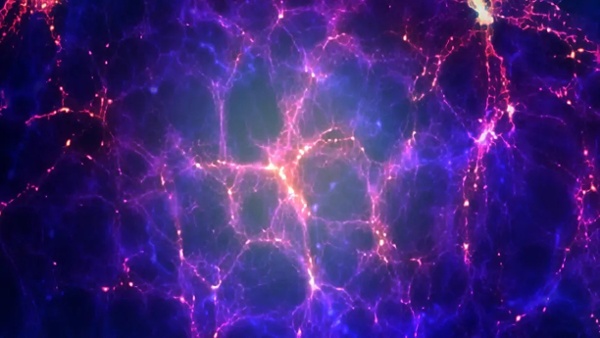
The debate between the two origin stories for the universe's magnetic fields has raged for years in the astronomical community. A pair of researchers based in Italy took on the challenge by measuring giant magnetic fields in the filaments of the cosmic web and then comparing those measurements with mock observations of simulated magnetic fields, to see if these filaments could be used to tease apart the two origin scenarios.
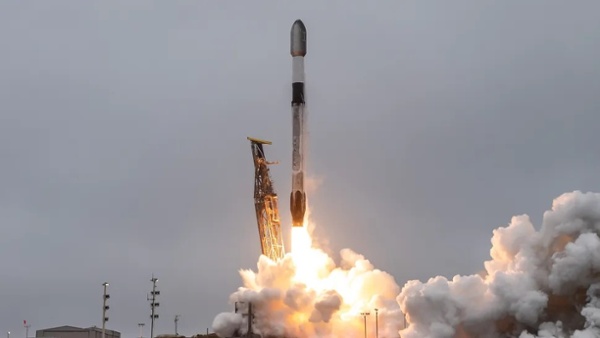
SpaceX launched another batch of its Starlink satellites from California yesterday. A Falcon 9 rocket launched SpaceX's Starlink 11-22 mission from Vandenberg Space Force Base today at 7:40 p.m. EDT (2340 GMT; 4:40 p.m. local time in California). The stack of 27 Starlink satellites began their journey into low Earth orbit (LEO) aboard a Falcon 9 first-stage booster designated B1063. This was the 26th launch of B1063, which has now supported 18 Starlink missions.
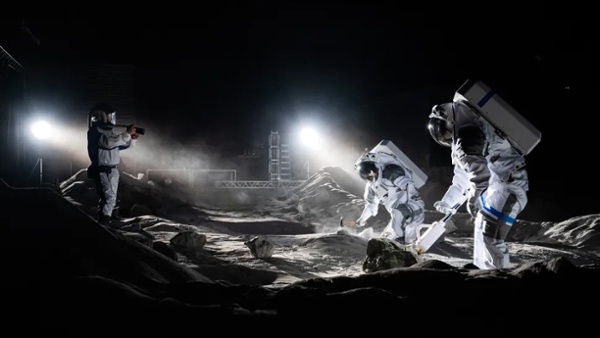
Pictures from a simulated moon landing, not designed to fool anyone into believing a fake but rather to provide a reference to make sure that we can get the best video images possible when astronauts finally do return to the moon, have been released by the European Space Agency (ESA).








No comments:
Post a Comment